Our Forum has recognised that more urbanisation, especially in Mumbai, is wreaking havoc on our Coastline, and the hazardous effects of unchecked urbanisation and industrialisation are only now being documented.
We thank the Times of India for this timely article:
TOI page 8, 3rd July 2010
North Maha coast is India’s most POLLUTED: STUDY
Green alert sounded for coastal waters & fishing zones being ruined by industrial & domestic waste
Chittaranjan Tembhekar | TNN
A major environmental disaster is brewing along the northern coastline of Maharashtra, which, according to a recent study done by the Goa-based National Institute of Oceanography (NIO) for the Maharashtra Pollution Control Board (MPCB), has higher levels of pollution than any other coastline in India.
The major reasons for industrial, domestic and port-based pollution along the northern portion of Maharashtra’s 720-km-long coastline are rapid industrialisation, urbanisation and a lack of control over the dumping of chemicals and pollutants into the Arabian Sea, especially in the Mumbai Metropolitan Region, says the study.
The study shows mainly minor environmental pollution along Maharashtra’s southern coastline, from Murud to Redi. But from Dahanu in the north to Murud, there are low levels of dissolved oxygen, suggesting an organic presence (chemical and domestic pollutants) in the water. Deepwater divers and special Navy boats helped the NIO and MPCB collect the water samples.
“The higher levels of hazardous chemicals in inshore waters along the northern Maharashtra coast as compared to the southern coast suggest high organic inputs due to anthropogenic activities, such as sewage, leading to severe deterioration in environmental activity in many instances,’’ says the survey.
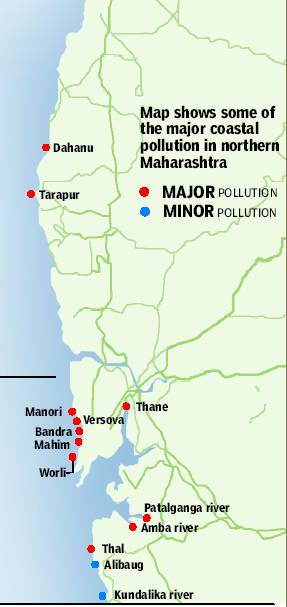
The Maharashtra coast stretches from Bordi or Dahanu in the north to Redi or Terekhol in the south. It is considered 30 to 50 km wide. The survey says there is relatively more petroleum contamination in the creeks of northern Maharashtra as compared to the south. Due to this, the fish catch in the creeks has been lower than in open-shore waters. There could be a risk to the breeding of commercially important fish and shellfish in the long run.
“The bacterial counts are higher in selected creeks and estuaries than in the open coast, suggesting high organic input to the coastal region. Mumbai coast and southern estuaries/creeks are more affected as compared to the rest of the coastal region,’’ states the survey.
The state’s shoreline is indented by numerous westward-flowing river mouths, creeks, bays and other water bodies. There are about 18 prominent creeks or estuaries along the coast, with most of them harbouring mangrove habitats.
“The coastal region of the state is a place of hectic human activity, intense urbanisation, enhanced industrialisation, resulting in degradation, directly or indirectly, of marine environment and hence this survey was carried out,’’ said an official in Mantralaya attached to the environment department.
The official said the study will help the state control the indiscriminate release of domestic and industrial effluents into coastal waters, the reclamation of saline land, offshore construction, the adverse effects of ship movements and the loading and uploading of cargo at ports.
The study also reveals that environmental conditions have deteriorated considerably in creeks and estuaries due to the weak flow of freshwater from dams or rivers into the sea during the dry, non-monsoon months.
Fishing For Answers
10 oceanography experts and scientists from Maharashtra and Goa went on special boats to do the study Year-long expedition started in February 2007 and ended in Aug 2008 Data was presented to state in 2009 NIO, MPCB collected coastal water samples & took underwater photos Divers and a Navy boat helped 1,100 samples were collected from 125 sites. They were tested for physical, chemical and biological components and nearly 25 environmental parameters.
Industrial sewage has been a major pollutant
Chittaranjan Tembhekar | TNN
Mumbai: The survey of coastal waters suggests that the influx of industrial waste into inner estuarine zones—tidal areas where the sea meets rivers—should be discouraged for new industries. Stringent measures are also suggested for the treatment of effluents that are presently released into the sea without any controls.
The study, done by the National Institute of Oceanography (NIO) for the Maharashtra Pollution Control Board (MPCB), warns of heavy environmental degradation if the measures are not taken seriously and immediately.
The study suggests that industrial effluents be emptied into waterways at more downstream locations wherever a crisis is observed. “In the case of existing discharges, a detailed site-specific survey should be conducted to assess the ecology of the estuarine segment receiving the contaminants. If the results, particularly of pre-monsoon periods, are unacceptable, the effluent release should be shifted to a suitable downstream location in the estuary where assured dilution is available so that the impact on the ecology is minimised,’’ the survey says.
The survey says the release of effluents meeting MPCB and Central Pollution Control Board norms in
estuaries where tidal flushing is high, should be permitted only after proper studies of pollutants and
the impact on the ecology. New industries should be persuaded to release treated effluents deep into the open sea at specific sites, as organic waste, particularly sewage, has been the major contaminant in estuaries, creeks and coastal waters of the state. The study says domestic sewage, if treated and disinfected, is not harmful to aquatic life, provided its release does not cause depletion of dissolved oxygen.
Hence, it is vital to assess the capacity of creeks and estuaries to assimilate organic waste. It suggests analyses of each creek and estuary in summer so that a plan can be drawn up to protect the environment and have sustainable development.
SAVING THE SHORE: The Next Steps
Effluent releases to inner creek/estuarine zones should be discouraged
For existing effluent discharges, a detailed site-specific survey should be conducted to assess whether the water body can assimilate the discharge
Existing effluent releases should be shifted downstream with additional treatment as required
Effluent releases may be permitted in the lower estuary (closer to the sea) only after asserting if the discharge can assimilative with the water



 Newlinkroad's Blog
Leave a comment