Following repeated complaints from residents, we as a Forum decided to take up the case of hazards from Mobile towers. We thank Times of India for publishing this article in today’s Times of India pg 24
Panel for cap on cell tower radiation
New Delhi: Sixteen years after mobile telephony entered India, the government has drawn up the first set of norms on electromagnetic field radiation from mobile base stations mounted on cellular towers, reports Shalini Singh.
An inter-ministerial committee has said the exposure limit for the radio frequency field should be brought down to one-tenth of the existing levels.


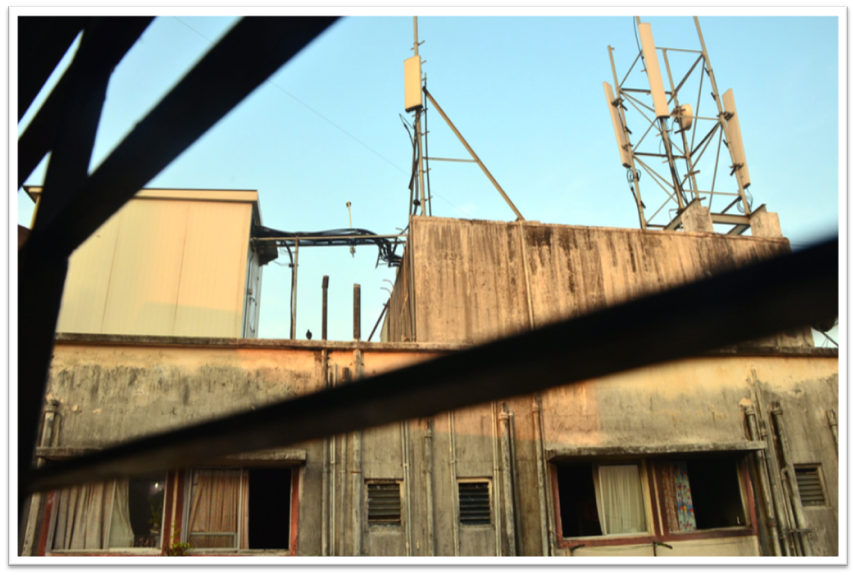
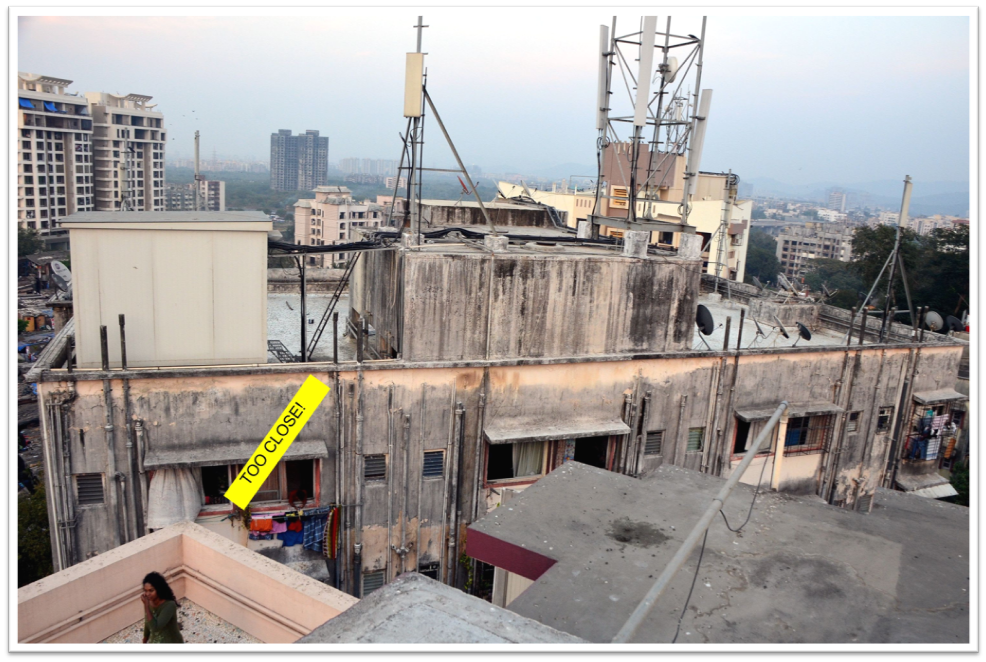
Mobile towers [without permission] within 20 feet of a residence in Mumbai
Provisions for online monitoring and display of radiation levels in mobile network frequency range at prominent places in metros and other cities as well as online data transfer to a central server must also be ensured. India’s mobile base to touch 100cr by 2014 Shalini Singh TNN
NewDelhi:In a development that will be welcomed, an inter-ministerial panel has laid down norms on cell tower radiation. According to Trai, India has about 4 lakh mobile towers, and the tower industry is a huge consumer of energy, using up about 2.7-crore units of electricity and over 200 crore litres of diesel every day. And the 3G/BWA rollout will require an additional one lakh towers to cater to a total of 100 crore subscribers by 2014.
A national database with information of all base stations and their emission compliance status is being readied and will be available on the department of telecom’s website. The committee had initially discussed imposing restrictions on mobile towers within school and hospital premises. The telecom ministry, however, qu ashed the recommendation and sought “uniform guidelines to enforce restrictions on setting up base transceiver station (BTS) towers along with appropriate framework to ensure structural safety clearance for towers set up on rooftops of buildings”. In the masterplans of towns and cities, the location of towers will be identified in consultation with the ministry of urban development. Also, new technology and low power transmitters will be installed with in-building solutions for future expansion of the mobile network.
The government has also decided to push for long-term scientific research related to health aspects of EMF radiation exposure from multiple antennae in shared infrastructure sites. While these guidelines seem ambitious, it remains to be seen if they can be implemented uniformly across the over 4 lakh mobile towers.
Organizations such as Greenpeace have repeatedly protested about the dangers caused by radiation emitted from such towers, including possible cancer, pushing the government to issue the norms.
Typically, a mobile network consists of mobile switching centres, each of which is connected to base station controllers, which in turn are connected to a base transceiver station installed on top of towers to facilitate the sending of signals from one BTS to another. The radius of each BTS varies between 500 metres and 8/ 10km, depending on subscriber usage, spectrum band and availability. Telecom towers that are groundbased are usually 200-to 400-foot high and used mostly in rural or semi-urban areas. Rooftop towers are more prevalent in urban areas.
CELL CHECKLIST
• Uniform guidelines to be issued to enforce curbs on setting up of BTS towers
• Towers will continue to be installed in hospitals and schools
• Exposure limit for base station emissions lowered to one-tenth of current level
• Continuous online monitoring and radiation display made mandatory
• India has 4 lakh mobile towers, another 1 lakh may come up by 2014
• Around 100 crore subscribers by 2014 will make India’s mobile network the second-largest





 Newlinkroad's Blog
Leave a comment