Wetlands near Mumbai city are dying, confirms Government
|
Clara.Lewis@timesgroup.com |
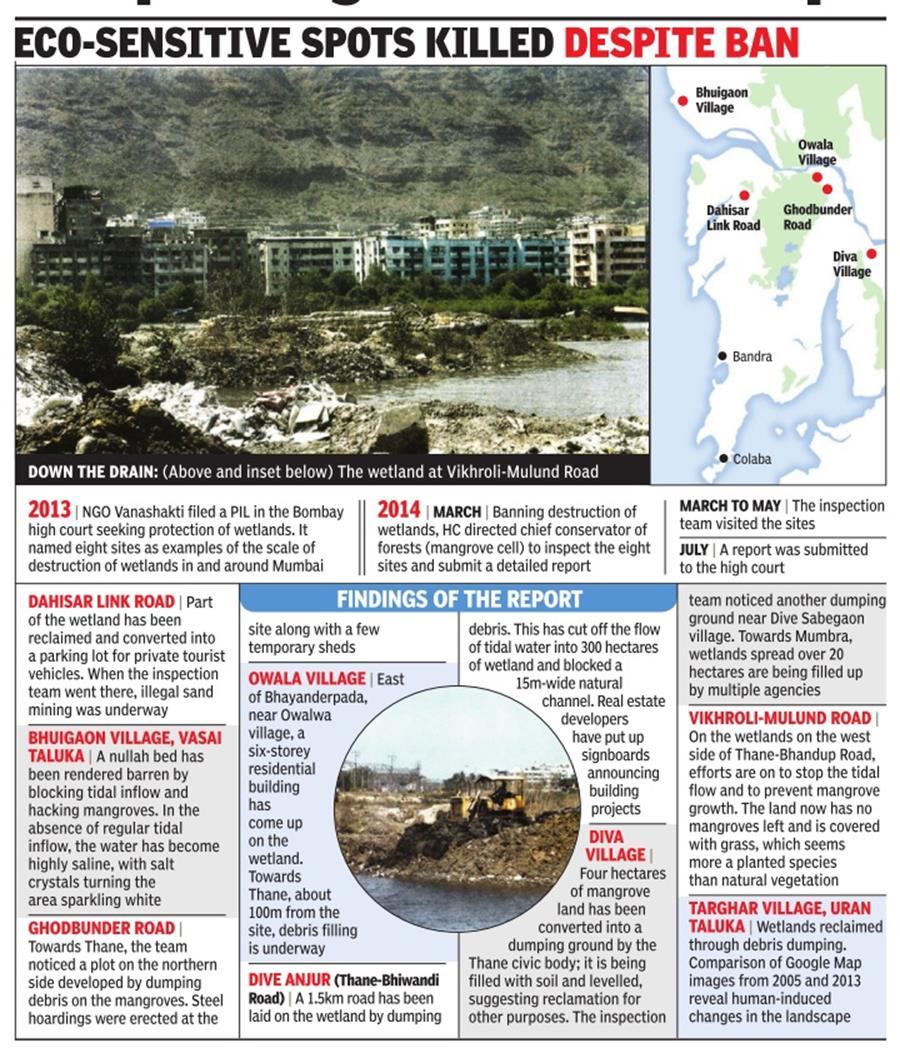
Despite a ban on their destruction, the wetlands in the coastal belts around Mumbai are being killed, a Bombay high court ordered report has revealed.
The damning report, prepared by the Chief Conservator of Forests (mangrove cell) N Vasudevan who inspected eight sites, found the wetlands being destroyed to make way for parking lots and realty projects.
In Mumbra the scale of destruction was found to be “outrageous”.

Figure 1 Dahisar wetlands used for bus parking and sand mining
Along Dahisar Link Road, the wetland was found converted into a parking lot. The inspecting team found illegal sand mining underway at the site.
The report was submitted last week.
Page 4 report in detail: Jul 30 2014 : The Times of India (Mumbai)
BATTLE FOR MANGROVES – Wetlands being reclaimed for realty projects & parking lots: Forest dept
|
Clara.Lewis@timesgroup.com |
The wetlands in the coastal belts around Mumbai are being killed to make way for development, the Maharashtra forest department has told the Bombay high court.
The court, while hearing a PIL by NGO Vanashakti in March, had banned all development on wetlands and instructed chief conservator of forests (mangrove cell) N Vasudevan to inspect the eight sites where the PIL said wetlands are being ruined. Vasudevan’s damning report, submitted last week, confirmed the continuing destruction despite the ban: the ecologically-significant wetlands around Mumbai are being reclaimed for parking lots and real estate projects.
In Dive-Anjur village, a 1.5km-long road (with 22m width and 7m height) has been laid on the wetland off the busy Thane Bhiwandi Road, cutting off the flow of tidal water to 300 hectares of wetlands. “It is noticeable from the highway and
shows the audacity of the perpetrators of this environmental outrage. Real estate developers have already put up signboards announcing their intention to take up building projects,” states the report. In Mumbra “the scale of destruction is outrageous,” the report says, pointing out that reclamation of nearly 20 hectares of wetlands by multiple agencies is currently underway.
Vasudevan’s team visited eight sites at Dahisar Link Road, Bhuigaon village in Vasai taluka, Owala village in Bhayander, Ghodbunder Road, Dive-Anjur village, Diva village and Diva Sabegaon village, Vikhroli-Mulund Road and Targhar village in Uran.
At Dahisar Link Road, close to the slum Ganpat Patil Nagar that is settled on a CRZ area, the wetland abutting the road has been reclaimed and converted into a parking lot for private tourist vehicles. When the court-appointed team visited the site, illegal sand mining was in full swing. Scores of trucks were lined up to transport the loot away and the water from the wetland was being drained using diesel pumps.
At Targhar village in Uran, the team discovered reclamation of the privately-owned wetland being carried out despite the HC ban. The owners told the team that they wanted to develop garages, container godowns and parking lots on the site.
At Diva village, a 4-hectare site was first ravaged by sand mining. Then to fill the pit the Thane municipal corporation converted it into a dumping ground. And now the soil is be ing filled and the land levelled for other purposes, said the report. Similarly , at Diva-Sabegaon village, the wetland has been become the site of wastedumping and construction of slums and chawls. Near Owala village, a 6-storey residential building has come up on the wetland. A housing finance company is offering loans for 1BHK flats, which are being sold for Rs 35 lakh, and 2BHK flats, which cost Rs 50 lakh.
Vasudevan points out in the report that wetlands are of tremendous ecological significance. They are rich repositories of bio-diversity and storehouses of water.




 Newlinkroad's Blog
Leave a comment