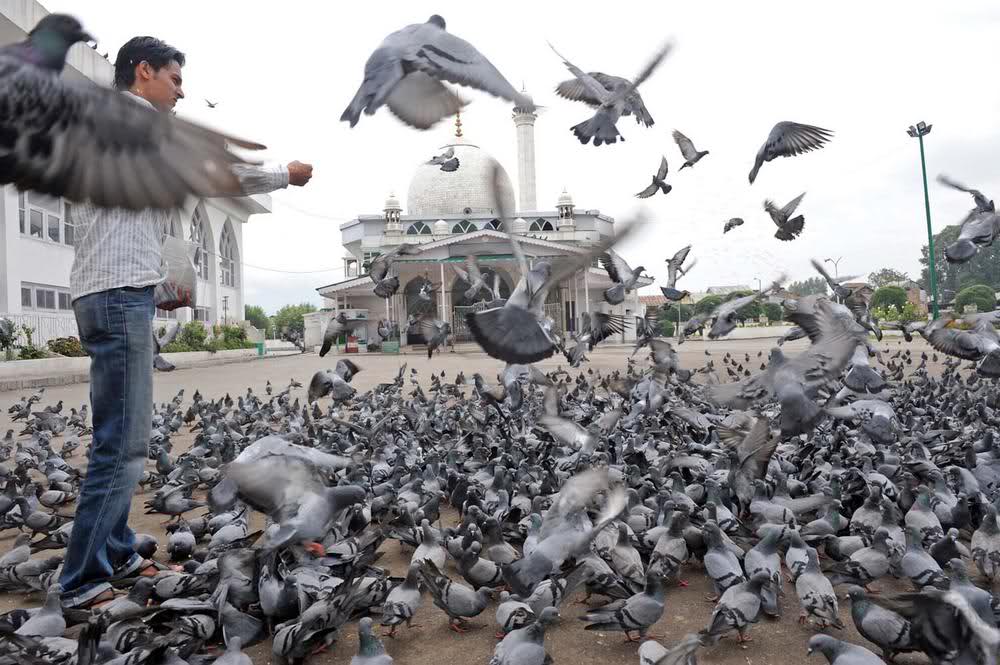
 Please do not encourage Pigeons by feeding them with precious foodgrains…
They are a health hazard to humans…
INFORMATION ON THE DANGEROUS EFFECTS OF PIGEON DROPPINGS
Pigeon droppings are extremely dangerous. They can carry all kinds of infectious diseases and parasites. They are especially dangerous when dried, because fine particles can be released into the air and then aspirated (inhaled). If you are going to handle them you should wear gloves and a mask and wash thoroughly afterwards. As with all infectious agents, young children, the elderly and people with compromised immune systems are particularly vulnerable.
Direct contact with pigeon droppings is not necessary to obtain the negative effects. The droppings, once dry, can become airborne and cause a higher risk of inhalation. Exposure to these fungi can infect the body without touching them with the skin.
Facts about pigeon-related diseases
The New York City Department of Health and Mental Hygiene (DOHMH) has developed this fact sheet to address common questions and concerns regarding pigeon-related diseases.
Pigeons are common to New York City. They often make nests in buildings and rapidly reproduce. Breeding occurs throughout the year, usually taking place between March and July. During these months, the DOHMH often receives questions about possible health risks associated with cleaning pigeon droppings. Contact with pigeon droppings may pose a small health risk. Three human diseases are known to be associated with pigeon droppings: histoplasmosis, cryptococcosis, and psittacosis.
Histoplasmosis
Histoplasmosis is a disease caused by a fungus, which grows in pigeon droppings. It also grows in soils and is found throughout the world. When cleaning droppings a person may breathe in some of the fungus, which in cases of high exposure can cause infection. Common activities, such as cleaning off windowsills, generally do not result in high exposures.
Symptoms of histoplasmosis begin to appear about 10 days after initial infection and include fatigue, fever, and chest pains. Most people, however, do not show any symptoms. Those with compromised immune systems such as cancer patients or people living with HIV/AIDS are generally more at risk of developing histoplasmosis. The disease cannot be transmitted from person to person.
Cryptococcosis
Cryptococcosis is another fungal disease associated with pigeon droppings and also grows in soils throughout the world. It is very unlikely that healthy people will become infected even at high levels of exposure. A major risk factor for infection is a compromised immune system.
Psittacosis
Psittacosis (also known as ornithosis or parrot fever) is a rare infectious disease that mainly affects parrots and parrot-like birds such as cockatiels, and parakeets, but may also affect other birds, such as pigeons. When bird droppings dry and become airborne people may inhale them and get sick.
In humans, this bacterial disease is characterized by: fatigue, fever, headache, rash, chills, and sometimes pneumonia. Symptoms develop about 10 days after exposure. Psittacosis can be treated with a common antibiotic.
Cleaning Up Pigeon Droppings
Protecting the health of both workers who clean up pigeon droppings and the general public is important.
General Public
Routine cleaning of droppings (e.g. from windowsills) does not pose a serious health risk to most people. Some simple precautions can be taken to further reduce direct contact with droppings, such as wearing disposable gloves and clothes that can be washed.
Workers
Before any extensive clean-up measures are taken – e.g., removing accumulations inside an air shaft – workers should be informed of the possible health risks involved, particularly those with weakened immune systems. Even though histoplasmosis, cryptococcosis, and psittacosis pose minor public health threats, they can be further minimized if safety measures are taken. Wearing protective clothing like disposable coveralls, boots, gloves, and respirators can be used for protection.
If a high-powered water hose is used to strip off dried droppings, dust control measures such as containing the area with plastic sheeting, should be taken. Wetting down the work area will prevent inhalation, reduce the risk of infection and will also prevent the spread of dust outside the work area. Those with a compromised immune system such as people living with HIV/AIDS or cancer patients should not be directly involved in the removal of the droppings. Always wash hands and any exposed skin before eating or drinking and when finished with work.
Several alternatives to using a high-powered water hose exist. One such alternative includes soaking the droppings with water and then shoveling it. The wet material should be collected in heavy-duty plastic bags or another type of secure container and discarded with the regular trash.
Once the structures are cleaned they should be regularly washed to prevent further accumulation of droppings.
According to the Feral Pigeon Control Environmental Health Guide, pigeons can cause “damage to buildings and monuments due to the highly corrosive nature of acid in pigeon droppings”




 Newlinkroad's Blog

Leave a reply to zeegreen Cancel reply